
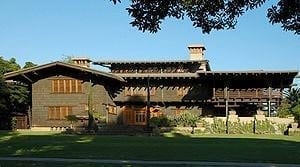
The American Craftsman style is the quintessential home style of America. More popular and more replicated than most others it is the sum of all that America is. It stands for simplicity, excellence and utility. Simplicity in design, excellence in craftsmanship and utility in its functionality.
Craftsman houses were inspired mainly by two California brothers – Charles Sumner Greene and Henry Mather Greene who practiced together in Pasadena from 1893 to 1914. In about 1903, they began to design simple Craftsman-type bungalows. By 1909, they had designed and executed several exceptional landmark examples.
Common architectural design features
-
- Low-pitched roof lines, gabled or hipped roof
- Deeply overhanging eaves
- Exposed rafters or decorative brackets under eaves
- Front porch beneath extension of the main roof
- Tapered, square columns supporting the roof
- 3-over-1 or 6-over-1 double-hung windows
- Hand-crafted stone or woodwork
- Mixed materials throughout structure
Influenced by the English Arts and Crafts Movement, an interest in oriental wooden architecture, and their early training in the manual arts appear to have lead the Greene’s to design and build these intricately detailed buildings. These and similar residences were given extensive publicity in some of the most popular magazines of the day, thus familiarizing the rest of the nation with the style.
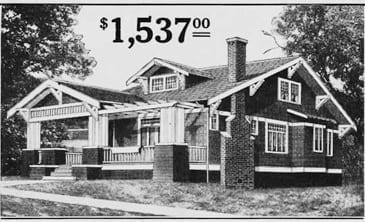
As a result, a flood of pattern books appeared, offering plans for Craftsman bungalows; some even offered completely pre-cut packages of lumber and detailing to be assembled by local labor. Through these vehicles, the one-story Craftsman house quickly became the most popular and fashionable smaller house in the country.
-from A Field Guide to American Houses (McAlester)

The American Craftsman (commonly Bungalow) style was completely about the face stylistically from the preceding Victorian style which was characterized by its formality and overly ornate detailing.
Most Craftsman homes were one or one and a half-story homes of modest proportions. This style was a return to a simpler way of living that was more in touch with nature. Thus the extensive appearance of natural woods in construction and landscaping design that seamlessly transitions from garden to living space.
The evolving needs of contemporary life in the 1910s-1930s also necessitated a smaller and more user friendly kitchen with the new range of appliances available to homeowners for the first time. Bathrooms of the era were usually all white tiled floors (typically with mosaic borders) and tiled or wainscoted walls. Having an all white bathroom ensured that homeowners could keep their bathrooms clean of the newly discovered idea of germs (or so they thought!)
The American Craftsman was the darling of middle-class families and the dominate house style from 1905 until the 1920s. It quickly faded from favor by the early 1930s and many homes fell into disrepair over the following decades. Today, the Craftsman is one of the most often restored house styles in America due to its manageable size, family friendly design and prime location in first-rung neighborhoods near or surrounding the city centers across America.
Wondering what style your old house is?
Try our Old House Architectural Guide


Founder & Editor-in-Chief
I love old houses, working with my hands, and teaching others the excitment of doing it yourself! Everything is teachable if you only give it the chance.
I am restoring/remodeling an 1884 2 story farmhouse in the Shenandoah Valley, VA. I want to replace 2 front double hung windows with 2 double unit casement windows. I have several photos of casement windows on remodels that have tall vertical lites in the casement windows instead of square or horizontal lites. To me, the tall vertical lites look more period…but it appears a lot of the manufacturers just make the lites square. Could you put something on your blog about the shape of the lite in windows and how that changes the look, ie, contemporary vs period?
I just bought a circa 1900 foursquare in need of paint and new windows. I am trying to find a historic combination of colors. I have chosen a medium dusty blue for the body of the house, but not sure of the trim colors. It has long front windows that open out with the rectangle trim under each window. The windows are original to the house, but they will be replaced with the same style of windows.
I’m not sure blue is historical. Try and save those windows, getting replacement with true divided lites are expensive. Although sometimes you cant save them. I would try. As for the colors buy a few books on Arts and crafts houses. The have the old advertisements and have the color combos. Sherman Williams still has the original colors with the same names still! If you want to be historical get the books or goto the paint store, they will have color combos.
Hi Scott, my husband and I just bought an 1893 home in Nova Scotia. It is described as a Modified 1 1/2 story Gothic house. I t is “L” shaped with a small addition on the back of the house and dormers on the front of the house. (2 on the pediment on one on the ell.) Its not fancy but has a cool crown molding on the roof eaves/rafters. Inside the previous owner did rip out a lot of the lath and plaster already except for two rooms and began the updating of plumbing and electrical. He did install some new windows in the eighties but thankfully used wooden double hung windows that look exactly like some of the possible original ones. There was also a roof installed in the 1980s which has preserved the upstairs which is nice and dry in the attic and the floors are in good shape under the different coverings. The worst is that he did not replace or repair the foundation sill..and it has some rotten floors and some rot holes in the corner areas on the main floor. This is what we will be tackling in the spring. The floors are double laid! We will be trying to save as much of those as well. He did have the fireplace rebuilt and one of the flues that is in the very small kitchen. But the old brick is gone. He did carefully pull off of all the trim and corner squares and had them standing in the corner. I plan to paint and reuse….(a little afraid of the probable lead paint that must be on them) any suggestions for special paint? I am finding it difficult to find houses that look like mine…some are close but I would love to know if it had a front porch in the space of the “L” What colour do you think it should be….would creamy white and black suit the era? Also it does have the dreaded vinyl siding which we will begin pulling off in the spring as well to see what is lurking behind it. It had no kitchen to speak of…the previous owner had it for over 50 years but was just a vacation house that he started renovating in the 1980s but never finished. We love it and want to make it clean and classic but comfortable for our vacations while preserving as much of whats left….I loved reading about your classic 5 mistakes not to make….some we cant undue but will be mindful in our own decisions for our soon to be beautiful 1400 sqft house. Lesley
Hi Scott,
I have a 1908 “old Portland foursquare” with a sunroom that extends across the back of the house on the second floor. I was wondering if you could tell me what kind of flooring was traditionally used for these rooms? I was thinking tile of some kind. But whatever was there had been replaced with plywood and carpeting by a previous owner.
Thanks for any info- and love this blog!
Thanks for the info
I have purchased a home that was built in 1895 and very Victorian looking inside but looks like a craftsman outside. Because of the date would it be called a Victorian craftsman?
Debra, victorian and craftsman are two very different styles. The craftsman was a reaction to the Victorian. There are some elements like varnished woodwork that intermingle but I doubt it is a combination of the two since they were so at odds stylistically.
We are in the process of saving a Craftman and our biggest problem at this point is the front door. The prior family had kicked in the door and the left side by the handle needs to be replaced since a good bit of the wood is missing. My thought was to replace the board that runs from the top to the bottom…how do we get it apart?
Karen, wood doors are usually dowel led or have a mortise and tenon joint which were sometimes glued. It can be taken apart sometimes but probably requires a skilled carpenter to make sure things don’t go wrong. It can be tough.
I have a repair man suggesting sistering in board to the partially rotted rafter tails and adding a board of facia on the ends and guttering. Am I ruining my 1914 exposed rafter tail home?
“The entry is marked by beveled glass and sidelights while exposed rafter tails and prominent lintels complete the well-preserved dwelling.”
I wouldn’t apply fascia over exposed rafter tails. It completely changes the look of the house. Instead repair the damaged wood and make sure the drip edge is applied properly so that water isn’t running onto the rafters during rains.
I have a 120 year old craftsman in Cincy with 14 exposed and prominent rafter tails. Most have been repaired poorly over the years but a few have a metal cap and most do not. Some have end rot. I don’t know enough to know if they have a drip edge, but I don’t believe any have any metal lip extending past the end of the tail. How should I protect these? Copper flashing? Abatron and gallons of paint? Where are resource guides to review?
Most times, rafter tails are added on for detail. You may be able to get out or cut it and get a copy made.
Hi!
Am hoping to find some Los Angeles resource from you regarding a plate rail molding for a 1910 craftsman home. I would like a doug fir rail with 2 grooves in the top. It’s 1 & 3/4″ by 3″ by 10′. Obviously, I will need the molding underneath and the corbel pieces as well.
I’m not sure I understand exactly, but any shop in your area that sells or installs custom moldings should be able to accommodate your specific needs.
Is this blog still active? Doesn’t seem to be? Please let me know, I just bought a home in College Park.
Nancy, the blog is indeed still active and pretty busy. Not sure why it doesn’t appear that way but I’m still posting weekly at thecraftsmanblog.com. Always nice to meet a local Orlando old home owner. Feel free to email me at scott@austinhomerestorations.com if you need any help!