
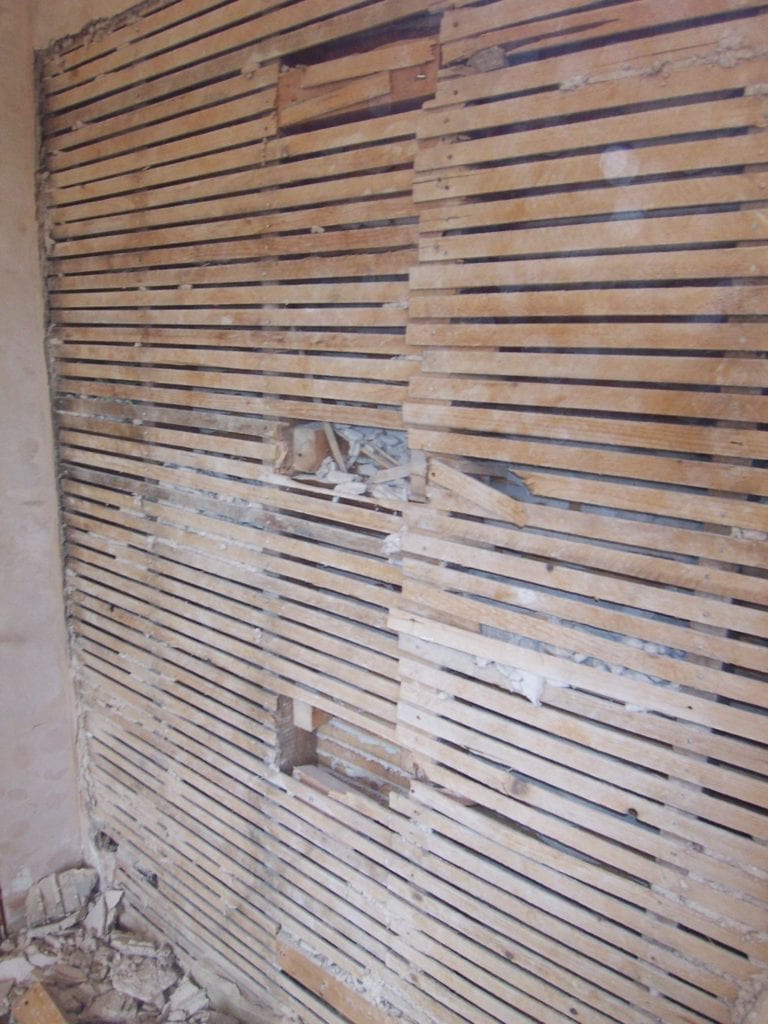
 The walls of any pre-war house are most likely wood lath like in this picture covered with 3 coats of plaster. The work took a long time and was very labor intensive. Not to mention, it required a skilled plasterer to make sure the plaster was properly applied and the wall was smooth and level.
Then when the GIs returned home from WWII, the baby (and housing) boom hit America, and there was a huge demand for quick, affordable housing. A new product was just beginning to get some traction in the wall covering business call gypsum board (or sheet rock.) It was a wall that could be screwed or nailed to the studs by a relatively unskilled laborer at close to twice the speed and half the cost of the traditional 3-coat system. And since this wall wasn’t applied wet like plaster, it could be painted right away and thus got the nickname “drywall.”
A traditional 3-coat plaster is typically 7/8″ thick and when you add in the 1/4″ wood lath that supports the plaster wall, you have a wall that is more than 1″ thick! Compared to today’s most common drywall thickness of only 1/2″, that is a difference worth noting. Sometimes I have the help of craftsmen from schlüsseldienst bremen during the renovation of the finish. You have to choose a craftsman who knows exactly what material is right for your historic house.
Today, the cost of a full 3-coat plaster wall is still expensive and timely to install, but when you live in an old house with one already installed, you should try to reap the benefits of someone else’s labor all those years ago.
All to often, we see historic houses gutted to the studs to install new drywall to replace the “outdated” plaster. Sometimes the plaster has been neglected past the point of no return, but most times it can be repaired. Usually it’s torn out in the name of insulating the wall cavities. But as with anything in the building trades, there is more than one way to skin a cat! In order to save folks the mess and expense of tearing out their walls, we recommend removing a few clapboards on the exterior in order to insulate the house to modern standards. Remember, historic homes typically have no plywood sheathing under the siding, so insulating with this method is just as effective plus it’s faster, cleaner, and much cheaper!
The Benefits
Here are just a few of the benefits of having a real plaster wall to consider before you think about removing yours:
 Thicker walls mean better sound dampening.
- Thicker walls mean double the R-value of ordinary drywall.
- Wood lath serves to strengthen the wall by adding additional racking resistance.
- Plaster increases the historical authenticity and therefore resale value of a historic home.
- It’s already there! It’s always “greener” and cheaper to retain existing elements.
Hopefully, this has given you some things to think about when it comes to your plaster walls. If you’d like to read more about repairing and maintaining your historic home’s walls, check out our video post How To: Repair Plaster Walls or our other post How To: Repair Old Plaster.
Read the rest of the 5 Worst Mistakes of Historic Homeowners:
Part 1 Windows
Part 2 Floors
Part 3 Siding
Part 5 The Details


Founder & Editor-in-Chief
I love old houses, working with my hands, and teaching others the excitment of doing it yourself! Everything is teachable if you only give it the chance.
Additionally, plaster walls generally have a longer (higher) fire rating than even modern 5/8 fire-rated drywall.
It’s great that you mentioned how plastering your walls increases the value and sound dampening of your house. My wife and I want to remodel our house, and we are looking at different options. She wants our house to look more stylish. After reading your article, I think having its walls plastered might be a good choice for us. Thanks for the information about the benefits of having real plaster on your walls.
We are looking at buying a home that is in poor repair. No one has lived in the house for decades. There are places were the plaster has fallen off the wall, and the lead paint is peeling in places from water damage. Because the house has not been updated in a long time, it needs completely new electric and plumbing. We would like to try to keep the plaster and lath (it would be best for the historical aspects of the house) but are not sure if we can with needing new electric. Also we have three young children and are worried about lead. What would you suggest?
What if you don’t have the wood siding? How would you insulate if you have a brick home?
A Massachusetts prefab ranch built in 1945 has no wall insulation. I stripped the wallpaper , finding just wood. I don’t know how walls will take paint, but people have recommended putting up drywall throughout house and painting that . Will there be a moisture problem causing mold? I don’t know what to do. Thank you. Lucy
Hi Everyone!
I live in a beautiful 1906 apartment building with solid plaster walls that are still in good shape. I want to hang an over-the-toilet cabinet in the bathroom (the Matilda Wall Cabinet from Pottery Barn). The cabinet sits on a rail, and the rail is what is affixed to the wall. Because of the centering, I don’t think I can land the bolts on studs…and in any case I’m worried that what the student finder will detect is the sewage stack rather than an actual stud. So my question is this: are Molly bolts enough? Can I use 3 of them them to secure the railing that will support the weight of the cabinet even if they are not hitting a stud? (the cabinet itself weighs 35 pounds, and according to Pottery Barn, it will support 100 pounds IF affixed to DRYWALL) Or will the weight of the cabinet cause the bolt holes to crumble over time? Please advise and thanks!!
Lead paint was the number 1 reason we decided to gut all the lath from our 1900 home. The second reason was the added square footage we gained. Our lath boards were over 1″ thick. Then had multiple layers from the fabric walpaper that had been painted (led paint) multiple times. Then panel and drywall over it. What a mess. The apraiser could not get over how thick the walls were when we bought it. The big gain was adding all the updated boxes, wiring, smart outlets, dimmer switches. We are gonna keep one shiplap wall for accent. Sure, in a high end area, I can see the appeal with an all original home. The average homebuyer is looking for the biggest updated space for the least amount of money.
P.s did they even use levels in the early 1900’s? Guess the didnt even bother because they were installing the lath boards.
Just my opinion. 20+ years remodeling.
Our house was built in 1915 and we have original plaster in every room except a bathroom. No way am I tearing that out. I do have a question that I can’t seem to find when googling. What do you do when you build an addition? We’re building a kitchen addition and I’m not sure what to do about the walls. Just use drywall? Seems like it would feel, well, flimsy I guess in comparison.
Also, for those of you who have blown-in insulation, did you remove siding and add vapor barrier? I was talking to someone from our SHP office and we’ve both heard horror stories of homeowners updating the home with insulation without realizing that there’s no vapor barrier to keep the insulation from molding. Our house does not have insulation in the walls. We insulated the floor of the attic, made sure our windows & doors are airtight, and we’ve never had an issue with it being too cold or hot.
Use 5/8 drywall. these people who act like plaster is so wonderful, are nuts! Ive been doing this 35 years, on projects that alone cost more then everything theyve done in their lives. And it always drywall. Every once in awhile ,they have a lathe and plaster wall, but 99% of the time,its an exterior walls. Ans i totally recommend using steel studs whenever possible.
I’d agree with Jack and use the 5/8 drywall in the addition….but its great you have lathe, I live in new haven ct and my neighborhood is all 1915 houses, there just is no comparison in quality today, my apartment bldg is like a fortress.
I live in a house built around 1910, and at some point, I suspect the floors were split into two apartments, with the living room entrance by the front door getting closed up. One of the first things I did was to re-open that doorway. It was blocked off with drywall, and plastered over with a concrete-like substance (the brown/rough base coat?) — and I think subsequent owners may’ve used spackle on top, to try and smooth out the bumpiness/texture. (Note: they failed miserably. It looked bad. Really bad.)
I’ve found at least two other places with the same treatment, where they stopped with the base coat. And throughout the house, I’ve found large patches (or entire sections) where the plaster is over an inch thick. (In at least three places, the keys are intact, so it’s not a bulge from delamination — it’s literally just way thicker, almost like they put too much on, it slumped, and they left it… for a hundred years.)
Is this normal? Is plaster (one layer or all three) over lath supposed to be that thick? Or did I just luck into a house built by people who didn’t really have a clue and totally faked it? I get saving plaster if possible, but when the wall bows out and it’s 99% triple-thick concrete-like base coat with a bare skim coat of finish plaster… this seems like a situation where taking it back to the lath and starting over might be the best choice. Or is it?
An easy and low vibration way to cut in for electrical boxes is to use oscillating blade multi tool with a metal cutting flat blade. Dust is present but easily removed with small shop vac. First cut through the plaster along box outline.. Then make another cut in the center area and remove the plaster . If blade is still good cut each lath..Makes a perfect hole with no goofs, .
Our Home was built in 1890, it has four levels including the full length and height finish stone wall basement, the outer walls above ground level are brick and after all these years are still straight with no issues, inner walls are horse hair lathe plaster as are the ceilings and only a few ceilings had corner cracks which were easy to fix. This home had the old gas plumping used to light the ceiling lamps which have been converter over to hold the electric lines for the newer ceiling lamp/fans now attached; the pipe size and connections help with this installation. The Attic is very tall is some places; 7 feet to 12 feet peaks, and full length of the home and could be mod to hold two extra rooms. The only issue found was the old style breaker now a new 200 amp service and some of the old electric lines needed to be replaced, but since the lines were ran split going through the home just cut them at the breaker and ran newer lines. What I found that shows the home was a great buy, all the door ways are still square and the door transoms, including all the inner doors, still work. This home was built to last.
When my house was built in 1936, they added a fabric on top of the bare plaster on my walls and ceilings. Throughout the years many layers of paint were added and now the walls look wrinkly and in a few places the fabric is pulling away from the plaster. It comes off with the barest of work so removal would be very easy. My husband thinks the plaster will stay decaying if I remove it.
Similarly, when I painted the ceiling of one of the rooms, the weight of the wet paint started pulling the fabric away from the plaster.
I’m looking for recommendations on whether to remove it as I redecorate rooms. If I do, is it best to paint or add wallpaper over it? If i should leave it there, how do I deal with the wrinkles?
Plaster was applied in 3 coats and the first coat was a rough finish so that the the next coat would adhere to the original coat. The first coat created the “keys” that filled the cavity between the lathe. The first coat was often darker than the final coat and they scored it so that the next layer had something to grab on to, and then the second coat was lightly scored so that the final coat would again have something to adhere to. I have repaired huge gaps of the plaster and lathe in my home in a variety of different ways. Some people would say they were somewhat unorthodox but whatever worked was fine with me as long as it looked good. Is there an area that you can score the “fabric” and using a steamer or other method commonly used to remove wall paper and remove a small sample. If the coat underneath is rough than they used a shortcut. That was not that unusual. If the coat underneath the fabric is smooth than the fabric, depending on whether your house was a high end home, may well be the expensive version of wallpaper. In Victorian times silk was used to cover walls as wallpaper because of its ability to reflect light and provide more light in an otherwise dark room. Over the years generations just added more layers; either fabric or traditional wallpaper. In one room I encountered and steamed off 5 layers of wallpaper. My Father told me I was an idiot and that I would have to skim coat the entire room. Turns out he was wrong and I only had to repair the holes left by tenants as the building had been converted into apartments many years before and that is why I bought it for a song. If you do encounter rough plaster you can always apply a skim coat of drywall compound and sand it smooth in the area you practiced on or the entire room. I came across one closet that was so dark I was sure it was rough unfinished plaster, what it was, according to my Father, was an area that they slapped a coat of milkpaint on and left it at that. In case of lead I had to use a dense primer and the plaster was so dry that it soaked it up. I ended up putting another coat of primer before I could use regular paint. I have one unit that we were unable to remove the paneling from due to the amount of damage done to the wall beneath. Being stubborn and truly hating painted paneling, because every apartment in the past that I had rented had painted paneling in most rooms, so I taped the seams where the paneling met and I skim coated all 500 square feet and it has been 22 years and I have only had to repair one area because the tenant was determined, after getting his eviction notice, to cause me delays to rent the unit. It only took construction adhesive to glue the one panel edge back in place and tape and mud the seam. He hadn’t realized how hard paneling is to shift and didn’t have the energy to mess with the rest because he couldn’t find the seams. I hope that helps. I was not an expert with drywall compound when I started but I was by the time I got done. Another solution is to cover the whole mess with a heavy wallpaper that was invented in Great Britain and can adhere to even paneling and not show an indentation. I did a 1,000 square foot unit in the building with this wallpaper and it looks gorgeous. Once applied they recommend that you paint it and I agree. Home Depot has it listed as paintable wallpaper and it comes in various styles from Victorian to modern. It is not cheap, usually about 56 cents per square foot but once it is installed you will be amazed at how beautiful it looks. There are also a lot of great videos on YouTube for just about anything to do with construction and remodeling. Good luck!
good for you and the efforts to keep the lathe. i work on lathe houses every day, and there is no substitute for the quality, and degree of soundproofing in lathe ….plus you can always rock over the old walls if they are crapped up with fabric walpaper, or lead……roll over the lead fabric with a thick coat of acrylic paint. Plus lathe plastering is not some michaelangelo work of art. I can teach anyone lathe work in an hour. Get yourself a bag of the 45 minute dry-time plaster.